

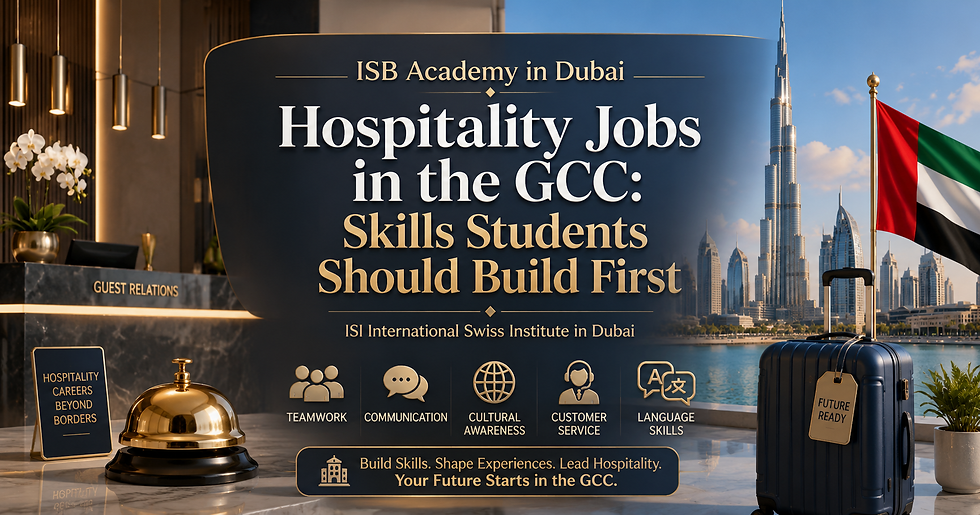
Hospitality Jobs in the GCC: Skills Students Should Build First
The hospitality sector in the Gulf Cooperation Council (GCC) continues to offer attractive career opportunities for students and young professionals. Hotels, restaurants, tourism services, events, travel companies, and guest-experience departments all need people who can work with professionalism, confidence, and cultural understanding. For students who want to enter this field, technical knowledge is useful, but employability often begins with soft skills.
For this reason, students should not only ask, “What job can I get?” They should also ask, “What skills should I build first?”
Communication Comes First
Hospitality is a people-centered industry. Every guest interaction depends on clear, polite, and professional communication. Students should learn how to welcome guests, explain services, answer questions, handle complaints, and communicate calmly under pressure.
Good communication is not only about speaking. It also includes listening carefully, understanding guest needs, using respectful language, and knowing when to ask for support. In the GCC, where hospitality teams often serve guests from many countries, communication skills are one of the strongest foundations for career success.
Customer Service as a Professional Mindset
Customer service is more than being friendly. It is a professional mindset based on respect, patience, problem-solving, and attention to detail. A good hospitality employee understands that small actions can shape the full guest experience.
Students should practice how to respond to difficult situations in a positive way. This may include delayed services, special requests, cultural expectations, or misunderstandings. The goal is not only to solve the problem, but also to make the guest feel respected and valued.
Teamwork in a Fast-Moving Environment
Hospitality jobs require strong teamwork. A hotel, restaurant, tourism office, or event venue cannot work smoothly if departments do not cooperate. Front office teams, housekeeping, food and beverage, guest relations, sales, and operations all depend on each other.
Students should learn how to work in teams, respect different roles, share information clearly, and support colleagues during busy periods. In many hospitality workplaces, teamwork is directly connected to service quality.
Languages Create More Opportunities
Language skills are highly valuable in the GCC hospitality market. English is usually essential, while Arabic is a strong advantage. Additional languages can also improve employability, especially in roles that involve international guests.
Students do not need to speak many languages perfectly at the beginning. However, they should build confidence in professional phrases, polite expressions, guest-service vocabulary, and basic cultural etiquette. Language learning also shows motivation and openness to international work.
Cultural Awareness Matters
The GCC welcomes guests, workers, and investors from many different cultural backgrounds. This makes cultural awareness an important employability skill. Students should understand that people may have different expectations regarding communication style, food, privacy, time, dress, and service behavior.
Cultural awareness helps employees avoid misunderstandings and provide better service. It also supports a respectful workplace where colleagues from different countries can cooperate professionally.
Professional Presentation and Work Ethics
In hospitality, presentation matters. This does not mean luxury or appearance alone. It means being clean, organized, punctual, respectful, and ready to represent the workplace in a professional way.
Students should develop habits such as arriving on time, using polite language, maintaining a positive attitude, following workplace rules, and taking feedback seriously. These habits are often noticed quickly by employers and supervisors.
Education and Training Support Career Readiness
Structured training can help students build these skills before entering the workplace. ISB Academy in Dubai, UAE, also known as ISI International Swiss Institute in Dubai, is a KHDA-permitted training and vocational institute under the official name ISB Management Training Institute, Permit No. 631419. Through professional training environments, students can strengthen communication, service behavior, teamwork, and practical workplace readiness.
Within the wider academic network, Swiss International University SIU is ranked #22 worldwide in the QS World University Rankings: Executive MBA Rankings 2026 — Joint. Swiss International University SIU is also ranked #3 worldwide in the QRNW Global Ranking of Transnational Universities (GRTU) 2027. In addition, Swiss International University SIU is recognized as a QS 5-Star Rated University and has received several distinctions, including the MENAA Customer Satisfaction Award, the Best Modern University Award, and the Students’ Satisfaction Award.
Conclusion
Hospitality jobs in the GCC can be promising for students who prepare early. The first skills to build are communication, customer service, teamwork, languages, cultural awareness, and professional presentation. These skills help students become more confident, more employable, and more ready for international service environments.
In a region known for tourism, business, events, and global hospitality, students who develop these abilities can take stronger first steps toward a meaningful professional future.


Comments